
Are you at a crossroads as you decide how best to start in engineering? Perhaps you’re torn between the academic routes or getting a job that pays the bills?
There’s several options to choose from, including college, school sixth forms, university, a T Level and going straight into work.
There’s only one option that lets you build a career and earn a salary from day one - an apprenticeship.
Make UK trains hundreds of apprentices every year for some of the biggest companies in the country and for hundreds of smaller manufacturers too.
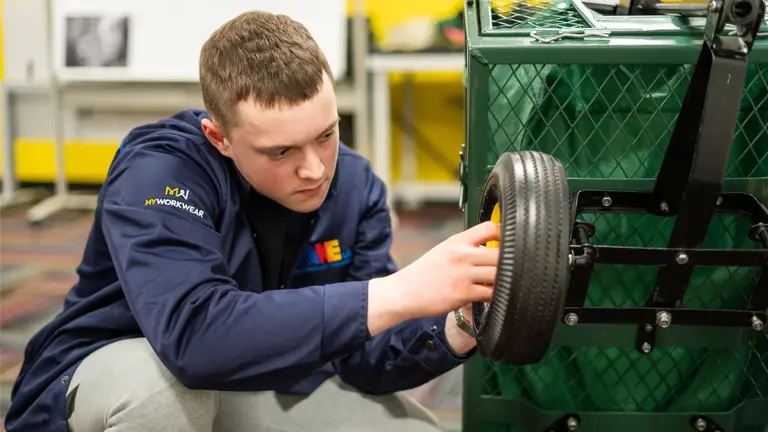
As the national body for UK manufacturing and a training provider ourselves, we’ve built our Tech Hub in Aston, Birmingham, around the equipment, tutors and workplace skills that gets you ready for the job.
Why choose an apprenticeship over a job?
Plenty of people get a job straight out of school and start earning money.
But there’s a difference between starting a short-term job and building a long-term career.
An apprenticeship gives you a salary from day one, four years of real workplace experience, a respected qualification and a clear career path once you’re qualified.
At the end of four years you’ve got no debt, and an employer who knows exactly what you can do.
Why choose an apprenticeship over university?
For a start, there’s no tuition fees and no student loans hanging over your head for years afterwards.
You’ll be earning as you learn, and your wage usually grows as you take on more responsibility.
We’re not saying that degrees aren’t right for some people, as for some careers they’ll be essential.
But for a start in engineering, an apprenticeship gets you a recognised qualification without the debt - and it doesn't close the door to university either.
Why choose an apprenticeship over college?
Full-time college usually means two years mostly in the classroom, and at the end of it, you still need to find a job.
An apprenticeship includes the classroom and workshop training, but you're paid from day one. You can use what you learn at the Tech Hub from day one at work.
If you’re not sure what you want to do and would like to keep your options open for longer, college is a good choice.
If you're ready to start, an apprenticeship gets you there sooner.
Where could an apprenticeship take me?
An apprenticeship with Make UK doesn't just get you qualified faster than the traditional academic route, it can take you further.
Apprentices go on to lead the departments they trained in. Many go on to management and leadership roles years earlier than a graduate route would allow.
And if you’re interested in travel, an apprenticeship can be a passport to working around the world. Apprenticeships are a transferable qualification, and larger employers may be able to offer time working at plants abroad.
Others become research and teaching technicians in university engineering departments.
How one apprentice rose to become a director
I always challenged myself, and kept looking ahead to see what was next. I ended up being a director before I turned 30
Richard Sadler started his apprenticeship on his 18th birthday, not really sure where it was going to lead.
Twenty-two years later he’s Group Engineering Director at Sertec, one of the UK’s top manufacturers, supplying companies like Jaguar Land Rover.
Richard spent the first year of his apprenticeship learning the fundamentals of engineering, including bench work, milling, turning, welding and CAD. Then he moved through various departments, seeing the shop floor, the tool room and purchasing and learning skills such as project management.
The grounding from his apprenticeship gave Richard a springboard to reach heights he would never have thought possible.
Apprenticeships are the first rung on a ladder that can lead to the boardroom. Read more stories of apprentices who were once in your position.
FAQs
The T in T Level stands for Technical, and it’s a two-year qualification you take after GCSEs that’s worth about three A Levels.
It’s mostly classroom-based, but you get about 45 days of industrial placements over the two years to give you some experience of the workplace.
The ratio of classroom to workplace in a T Level is almost completely opposite that of an apprenticeship, where you spend the majority of your time on the shop floor.
Make UK supports T Levels, and plenty of these students go on to apprenticeships with us once they’ve got a taste of the industry.
Being skilled academically doesn’t mean an apprenticeship is beneath you. It means you’ll get more out of it.
As well as getting an academic grounding in engineering, you’ll also have a practical understanding of how the tooling and processes work.
One of our apprentices was being pushed towards top universities by her school, but she applied for an apprenticeship after attending an open day.
Despite being warned by her teachers that she wouldn’t be any good, she’s since won an industry award and manages supplier relationships at manufacturing company Knore Bremse.
Read more about Megan’s story here.
There’s no right or wrong route into an apprenticeship, and some of our strongest candidates arrived in the same place as you.
We've trained apprentices who came to us from nursing, from landscaping, and even from art and design.
Apprentices have joined us at age 34, and others have spent two years in dead-end jobs before finding their home with us.
Not everyone knows exactly what they want to do at the same age. But all of them have found a career that’s right for them now.
Read more apprentice stories here.
Absolutely. We've trained apprentices who studied archaeology, and others who started degrees in civil engineering before changing their minds.
Whatever you studied, the time wasn't wasted. You’ll be amazed how you find a use for the skills you’ve learned along the way.
And sometimes the best way to work out what you want to do is to realise what you don’t want to do first.
There's no upper age limit on starting an apprenticeship.
Apprentices join us at every stage of life, often after finding that they weren’t enjoying a previous career.
What matters is that you’re ready to launch an engineering career, not how old you are.
Our apprentices come from across the UK, and our residential option means that training at the Technology Hub is open to everyone.
Find out what living and training at the Technology Hub is really like.
The way we check your progress is a bit different to the school exams you’re used to.
You’ll be assessed on what you can actually do. So you’ll have practical skills checks alongside written tests on your knowledge.
This all builds up to your End Point Assessment, which is the final stage of your apprenticeship, where we check that you’ve met the expected standard.
It's there to confirm your abilities, not catch you out. By this point, your employer will already know you're ready.
Ready to find the right fit for you?
See what different apprenticeships and skills you could choose from.
Or read what you’ll actually learn during your apprenticeship.
Still not sure? Read the stories of the apprentices who've already made this choice, or take a look at the facility where you would be training.