
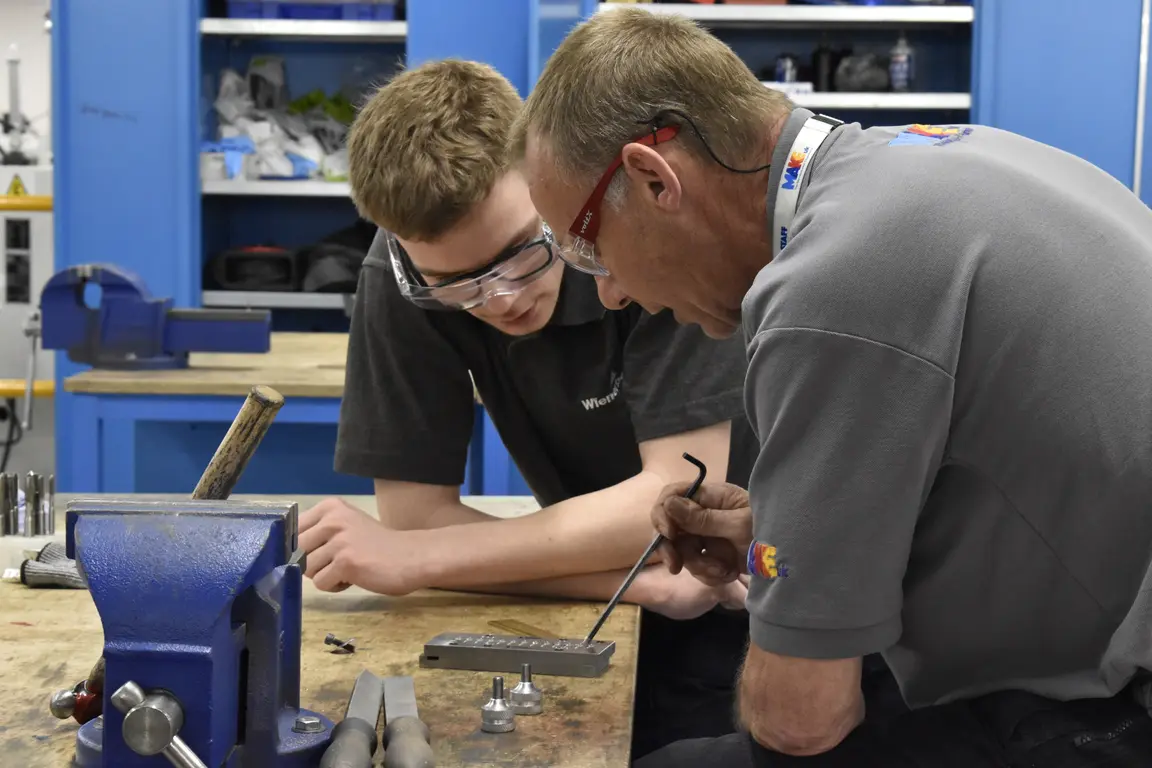
Employers get
a fitter who can interpret drawings and specifications, plan and prepare their own work, and produce, refurbish or assemble complex, high-value components and equipment to spec, with minimum supervision.
Learners get
a Level 3 qualification recognised by the Institution of Engineering and Technology (IET), opening the door to fitting roles across manufacturing, energy and process industries, working on some of the most technically demanding equipment in the sector.
Key information
LEVEL - Level 3
DURATION - Typically 42 - 48 months
QUALIFICATION - Level 3 Engineering Apprenticeship - Engineering Fitter (ST0432)
FUNDING BAND - £21,000
Fitters produce complex, high-value, low-volume components and assemblies.
This is the specialist work behind equipment such as turbines, cranes, gearboxes, production lines, rigs and platforms.
Apprentices are evaluated by an independent end-point assessor and awarded a Pearson BTEC Level 3 Diploma in Advanced Manufacturing Engineering. The standard also carries professional recognition with the IET for becoming an engineering technician (Eng Tech).
Make UK is the national body for UK manufacturing, and our Tech Hub in Aston trains engineering apprentices for employers of all sizes.
Training happens in a purpose-built facility with industry-experienced tutors, rated 4.8 on Trustpilot and Ofsted Grade 2, working with employers of every size and sector.
And if you'd like to see the equipment and facilities behind this training for yourself, take a look at the Tech Hub.
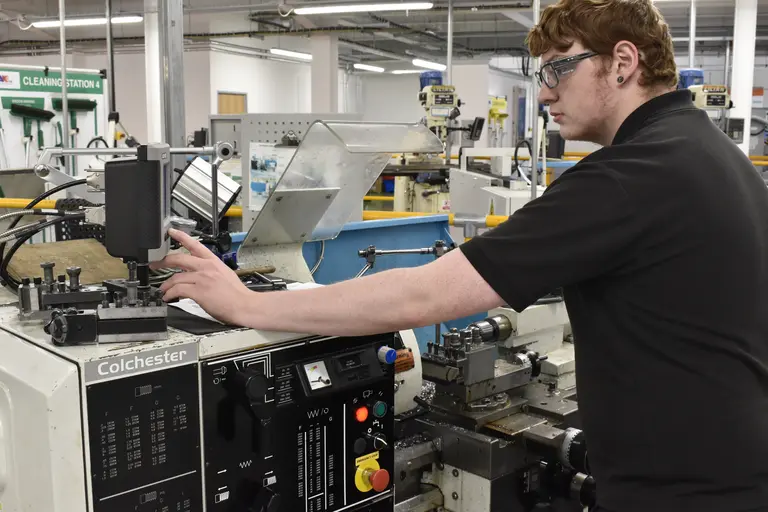
FAQs
A fitter trained through Make UK can interpret drawings, diagrams and specifications. They can plan their own work, sourcing the right tools, equipment and resources before they start.
They can produce individual components such as keys, pipework, threading, wiring looms, interfacing parts, motors and wiring cables. They can also refurbish existing components, and assemble these parts into equipment, machines or systems.
Qualified fitters can quality-check and adjust their work against specification using testing and calibrating, and they can diagnose and resolve problems when something doesn't meet standard.
They can hand over finished work and prepare the work area and equipment ready for the next task.
Fitters trained to this standard may have a mechanical, electrical, electronic, control systems, pipe fitting or instrumentation bias, and can work in a workshop or on client premises, including hazardous environments.
They work with minimum supervision, individually or as part of a team of fitters, and work with line managers, installation and maintenance engineers, health and safety and quality assurance colleagues, and internal or external customers.
Typical job titles: Controls and systems fitter, electrical fitter, electronic fitter, instrumentation fitter, mechanical fitter, pipe fitter.
As an engineering fitter apprentice, you'll spend most of your time in the workplace, producing, refurbishing and assembling components on real jobs.
You’ll attend the Make UK Tech Hub in Aston for block release training towards a Pearson BTEC Level 3 Diploma in Advanced Manufacturing Engineering, typically completed over two to three years.
This covers engineering materials, mechanical, electrical and hydraulic systems, engineering drawing, maintenance procedures, fault diagnosis, manufacturing planning and Industry 4.0.
In your first year, you’ll complete practical skills training in hand-fitting, mechanical and fluid power maintenance, electrical wiring and testing, fault location and general fabrication and welding, giving you a broad hands-on grounding before you specialise.
By the time you finish, you'll be able to work from complex drawings and specifications, produce and assemble components to tight tolerances, and diagnose and fix problems independently.
Employers can add specialist modules in electrical, electronics, CAD or robotics at an additional cost.
Employers who want fuller, formally assessed competence evidence can also opt into an EAL Level 3 NVQ in Engineering Mechanical Manufacturing. This isn’t a mandatory part of the standard and doesn’t require further time at the Tech Hub. Itis assessed in the workplace across years two to four of the apprenticeship, for an additional registration and certification cost.
Fitters move into senior and lead fitter roles, specialist technical positions, engineering supervision, and further engineering study.
The programme typically takes 42 to 48 months. The practical period leading up to final gateway is typically 42 months, with exact timings depending on prior experience, occupational role and an assessment of prior learning and knowledge.
Training is split between your workplace and block release periods at the Make UK Tech Hub. The block release schedule is confirmed well in advance so your employer can plan around it.
Before moving to End-Point Assessment (EPA), your employer must confirm you’re consistently working at or above the occupational standard and can operate safely in a fitting environment.
You’ll also need to have achieved the Level 3 Advanced Manufacturing Engineering Diploma, submitted an employer-authenticated portfolio of evidence, agreed a workplace-relevant project with your employer and the assessment provider, and achieved English and maths in line with the apprenticeship funding rules.
End-point assessment typically takes four months and consists of a project with a report, a multiple-choice test and a professional discussion.
The project and professional discussion are each graded Fail, Pass or Distinction. The multiple-choice test is graded Fail or Pass. Your overall apprenticeship grade is Fail, Pass or Distinction.
This qualification is for new entrants starting out in fitting, and no prior experience is expected.
Apprentices who are precise, methodical and comfortable working to tight tolerances and detailed specifications will get a strong grounding across mechanical, electrical and fluid power fitting.
Applicants will need four GCSEs at grade 4 or above, including Maths, plus English at grade 4 or above. Anyone with English below grade 4 will need at least a grade 3, and if they're under 18 at enrolment, they'll continue studying English and work towards Level 2 Functional Skills within their first year.
The Engineering Fitter – Level 3 apprenticeship is government-funded through the apprenticeship levy. The funding band for this programme is £21,000.
If your business pays into the Growth and Skills Levy, training costs are drawn from your levy account.
If your payroll is under £3 million a year, you don't pay the levy. The government covers 95% of training costs and you contribute 5% of the training fee plus the apprentice's wage, which must be in line with the national apprenticeship wage.
Optional appreciation weeks are charged separately, at £950 per module, and are agreed with your employer before the programme starts.
The optional EAL Level 3 NVQ is not a mandatory part of the standard and cannot be funded through the levy or non-levy funding rules. It carries its own registration and certification cost, agreed with your employer separately.
Find out more about how funding works here.
Ready to take the next step?
For employers
If this sounds like the right course for your business, the next step is to talk to us about your specific needs and find out how you can take on an apprentice engineering fitter.
Learn more about how the full process works for you, from your first call to us, to your apprentice starting work.
Have all your questions answered by visiting our Tech Hub in Aston, where you can see how the training works for yourself before making a commitment.
If you're still weighing up whether an apprenticeship is right for your business, see why employers take on apprentices.
For learners
If you’re keen to pursue a career as a fitter, find out how to apply and what to expect from the process.
Find out what training at the Tech Hub is really like, with stories from apprentices who were once in your position.
Not sure if welding is right for you? See what other programmes are available to you.
If you're a learner deciding whether this route is for you, read why an apprenticeship could work for you.
Talk to the team who deliver the training
This form goes straight to our apprenticeships team at the Tech Hub, not a general inbox.
If you’re an employer
A member of our team will be in touch to talk through what you need. We can help you work out whether this is the right programme, explain how funding works for your business, or arrange a visit so you can see the Tech Hub for yourself. There’s no obligation. Just tell us what you need.
If you’re thinking about an apprenticeship
We’ll get back to you to help with your questions about the programme and how to apply. Most of our apprentices are recruited directly by their employer, so there are more opportunities than our vacancy list shows. If you can’t see the right role, ask us.