Machinery safety regulation is changing again – what UK manufacturers need to know now
11.05.2026
If you design, manufacture, modify or supply machinery, including equipment that relies on software, automation or safety‑related control systems, new machinery safety regulations are likely to affect you over the next 12–18 months.
This matters whether:
- you place machinery on the UK market
- export to the EU or Northern Ireland
- build machines for internal use
- upgrade existing equipment with new controls or software.
While recent years have been characterised by delays and temporary extensions, recent regulatory developments signal a more substantive change ahead.
In early 2026, the UK Government confirmed its intention to update the Supply of Machinery (Safety) Regulations to broadly align with the EU’s new Machinery Regulation, with changes expected to take effect from 2027. At the same time, the EU has finalised major updates to both general product safety and machinery‑specific legislation.
Taken together, these changes represent the most significant shift in machinery safety regulation in over a decade, not because of marking requirements, but because of how safety itself is now defined, assessed and enforced.
What counts as ‘machinery’ in this context
In regulatory terms, “machinery” is defined very broadly. It covers any powered assembly of linked components where at least one part moves and which is designed to perform a specific application.
In practice, this includes far more than large standalone machines. Machinery safety rules apply to production equipment, automated systems, conveyors, robotics, and machinery built for internal use, as well as to equipment that has been substantially modified or upgraded. Where software or control systems play a safety role, this becomes increasingly relevant.
As machinery becomes more digital and interconnected, the boundary between mechanical equipment and software‑driven systems is becoming less clear and regulation is evolving to reflect that reality.
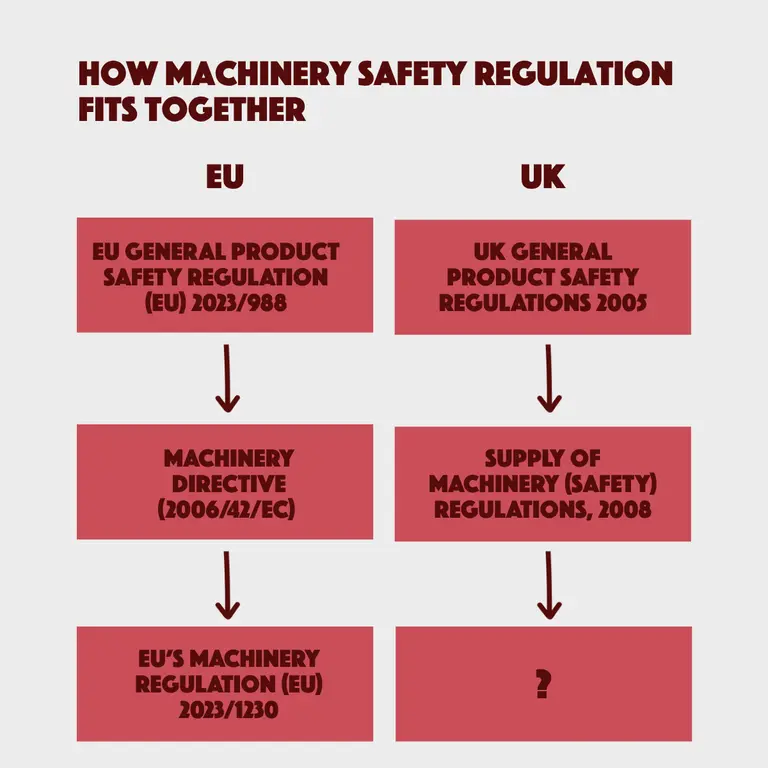
How machinery safety regulation fits together
To understand what is changing, it helps to see machinery safety as part of a wider product safety framework.
All products placed on the market are subject to general safety requirements - through the EU General Product Safety Regulation (EU) 2023/988 (which replaced the previous General Product Safety Directive) and, in the UK, the UK General Product Safety Regulations 2005
These set out the following duties on producers and distributors:
- Risk assessment
- Provision of warnings and instructions
- Monitoring product safety and taking corrective action (withdrawal/recall)
Machinery then sits within a more specific layer of regulation - the Machinery Directive (2006/42/EC) which was transposed into UK law via the Supply of Machinery (Safety) Regulations, 2008.
According to these regulations, if you produce machinery (even for your own use), you are required to:
- Carry out a risk assessment
- Design and construct the machinery to meet the Essential Health and Safety Requirements in Schedule 2, Annex I
- Prepare a Technical File
- Provide instructions for use
- Issue a Declaration of Conformity (or Declaration of Incorporation for partly completed machinery)
- Apply the appropriate conformity marking (such as CE marking, depending on the market supplied)
Historically, this machinery‑specific framework has focused heavily on mechanical hazards and physical safeguarding.
The updated regulations expand this scope, reflecting how machines are now designed, controlled and used in practice. They reflect a recognition that modern machinery is no longer purely mechanical. Software‑based controls, connectivity, artificial intelligence and remote updates are now commonplace, and existing regulatory frameworks were not designed with these risks in mind.
As a result, machinery safety regulation is evolving from a system focused largely on physical hazards at the point of supply, to one that looks at systems, software and safety over the lifecycle of a machine.
What the new EU Machinery Regulation introduces
The EU’s Machinery Regulation, due to apply from 2027 following a transition period, introduces a number of changes that are particularly relevant to UK manufacturers who export to the EU or Northern Ireland, and to those supplying the GB market as UK rules are updated.
Key developments include:
- New rules for AI, software & cybersecurity, including explicit safety requirements for:
- AI‑based safety functions
- Self‑learning systems
- Cybersecurity of safety‑related control systems
- Protection against corruption, manipulation and unintended software changes becomes part of the essential health and safety requirements.
- The former Annex IV list is replaced by Annex I (Parts A and B), meaning certain high‑risk machinery must now involve a notified body.
- Self‑certification based solely on harmonised standards is no longer permitted for some categories (notably AI‑driven safety systems).
- Digital documentation becomes lawful, meaning that digital instructions for use are explicitly permitted, but paper manuals must still be provided on request.
These changes do not mean that all machinery will suddenly require a different conformity route. However, they do mean that manufacturers will need to think more carefully about how safety is achieved and evidenced, particularly where software plays a role.
What about the UK
The Government has confirmed that CE marking will continue to be recognised in the UK indefinitely.
However, updates to the Supply of Machinery (Safety) Regulations 2008 are expected, with proposed changes broadly aligning to the EU’s Machinery Regulation (EU) 2023/1230.
These developments follow a consultation, which highlighted strong industry support for regulatory continuity and reduced trade friction. While the EU Machinery Regulation will apply directly in Northern Ireland from 2027, Great Britain is expected to adopt similar safety requirements, adapted to fit the UK regulatory framework.
Overall, the Government’s approach is intended to protect users, maintain access to key markets, minimise duplication for manufacturers, and provide greater stability for businesses operating across both UK and EU markets.
What this means for UK manufacturers
For UK manufacturers, the immediate message from government has been one of continuity: CE marking will continue to be recognised in Great Britain, and regulatory alignment aims to minimise unnecessary divergence.
At the same time, alignment with the EU’s updated approach signals that expectations around machinery safety will rise, even where marking requirements remain stable.
In practice, this means manufacturers should begin to consider:
- Whether existing machines include software‑based or connected safety functions
- How updates, changes or cybersecurity risks are managed over the life of the machine
- Whether current conformity processes will remain appropriate as rules evolve
- What evidence exists to demonstrate continued compliance, not just initial safety
For some businesses, these questions will confirm that little needs to change. For others, they will highlight areas that require further review.
Preparing for what comes next
Our recommendation is to start trying to understand how forthcoming changes relate to your existing machinery, and identifying whether further work will be needed as the new framework beds in.
Make UK will continue to share updates as this picture develops, and to support manufacturers in making sense of how regulatory change applies in practice.
Member support
Make UK Environment, Health and Safety members can log in to the Member’s Area to access a checklist designed to help assess how these changes may apply to existing machinery.
Need further support?
The impact of these changes will vary depending on the type of equipment you manufacture, how it is controlled, and where it is supplied. If you would like support in understanding how evolving machinery safety regulations apply to your business, Make UK can help - from early scoping and interpretation through to training and practical compliance support.