
Employers get
a welder who can work to industry standards across multiple processes, materials and positions from day one in your business.
Learners get
a qualification that opens the door to roles in aerospace, defence, construction, marine and structural engineering.
Key information
LEVEL - Level 2
DURATION - Typically 18 months
QUALIFICATION - Level 2 Engineering Apprenticeship — Welder (ST0349)
FUNDING BAND - £13,000
Welding is one of the most in-demand skills in UK manufacturing, and this programme produces a qualified welder to the national occupational standard.
Candidates are evaluated by an independent end-point assessor and certified to internationally recognised welding approval standards.
Make UK is the national body for UK manufacturing, and our Tech Hub in Aston trains engineering apprentices for employers of all sizes.
Training happens in a purpose-built facility with industry-experienced tutors, rated 4.8 on Trustpilot and Ofsted Grade 2, working with employers of every size and sector.
And if you'd like to see the equipment and facilities behind this training for yourself, take a look at the Tech Hub.
FAQs
A welder trained through Make UK can produce manual and mechanised arc welds to sector standards. They can work across a minimum of two welding processes, including at least one manual process. They weld in multiple positions in several joint configurations across materials including carbon steel, stainless steel and aluminium.
They can work in down-hand, horizontal, vertical and overhead positions and produce butt, T-butt, fillet and cladding joints. They can set and adjust welding controls — current, arc voltage, wire feed speed, gas flow rates — and adapt their technique to the material and process in front of them.
Qualified welders can ensure their work meets quality standards and is made to schedule.
They can read and interpret technical drawings, identify surface defects and carry out visual and dimensional checks. They work safely, independently and to the tolerances your quality process requires.
Welders trained to this standard work in sectors including aerospace, construction, defence, marine and structural engineering. They can work in any size of business, in settings including fabrication shops, assembly yards, factories and site-based operational environments.
They can work with other teams, including plate fabricators, steel erectors, steel workers, riggers, stores operatives, supervisors, inspectors, testing and quality control technicians.
Typical job titles: Welder, structural welder, fabricator-welder, coded welder, MIG/TIG welder, aerospace welder.
As a welder apprentice, you'll spend most of your time in the workplace welding, learning and building up the practical hours your qualification requires.
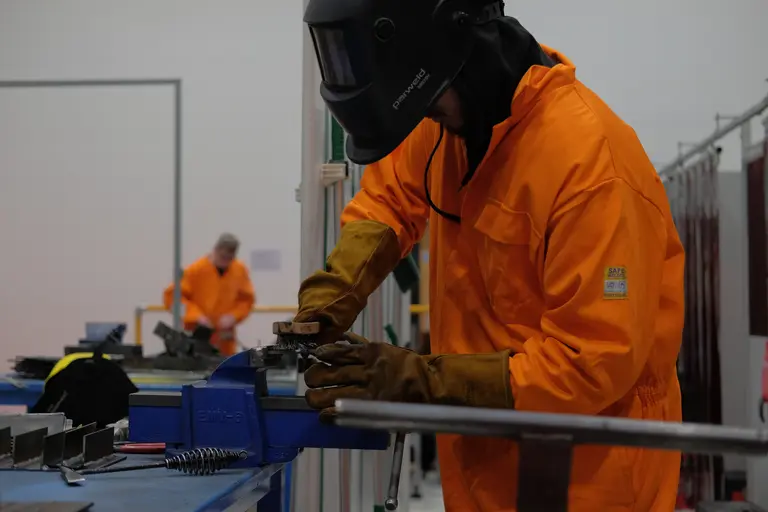
You’ll also attend the Make UK Tech Hub in Aston for block release training, where you’ll immerse yourself in specific techniques, using industry-grade equipment and developing a greater depth of skill.
By the time you finish, you'll be able to weld to internationally recognised certification standards across multiple processes and materials.
You'll have spent time on TIG, MIG, MMA and other arc welding processes, worked with different material groups and produced welds in the full range of positions. You'll understand the science behind what you're doing, including metallurgy, heat management and quality control.
This is a trade with real career progression. Welders move into coded welder roles, inspection and NDT, welding engineering, supervisory positions and, eventually, management and technical specialist careers.
The programme typically takes 18 months, with exact timings dependent on prior experience and the occupational role.
Training lasts around 15 months, split between your workplace and block release periods at the Make UK Technology HubTech Hub. The block release schedule is confirmed well in advance so your employer can plan around it.
When your employer confirms you’re working at or above the occupational standard, you’ll move to End-Point Assessment (EPA).
End-point Assessment takes around three months and consists of a multiple choice knowledge test, a practical welding test with questions and an interview. You'll also need two current welder approval certificates to recognised international standards.
Results are graded Fail, Pass or Distinction.
This qualification is for new entrants who are starting in welding, and no prior welding experience is expected.
Candidates who are practical and ready to learn a skilled trade will get a headstart in a career that’s in great demand.
Applicants will need four GCSEs at grade 3 or above, including Maths, plus English at grade 2 or above. Anyone still working towards those grades, can study towards these in the programme.
The General welder – Level 2 engineering apprenticeship is government-funded through the apprenticeship levy. The funding band for this programme is £13,000.
If your business pays into the Growth and Skills Levy, training costs are drawn from your levy account.
If your payroll is under £3 million a year, you don't pay the levy. The government covers 95% of training costs and you contribute 5% of the training fee plus the apprentice's wage, which must be in line with the national apprenticeship wage.
Find out more about how funding works here.
Ready to take the next step?
For employers
If this sounds like the right course for your business, the next step is to talk to us about your specific needs and how taking on an apprentice welder works.
You can find out more about the full process, and learn how it works for employers like you from your first enquiry to your apprentice starting work.
The best way to answer all your questions is to visit our Tech Hub in Aston, where you can see how the training works for yourself before making a commitment.
If you're still weighing up whether an apprenticeship is right for your business, see why employers take on apprentices.
For learners
If you’re keen to pursue a career in welding, find out how to apply and what to expect from the process.
Find out what training at the Tech Hub is really like, with stories from apprentices who were once in your position.
Not sure if welding is right for you? See what other programmes are available to you.
If you're a learner deciding whether this route is for you, read why an apprenticeship could work for you.